Learning & Development / Selected Work
Training people can use after the meeting ends.
I help turn complicated systems and processes into learning experiences that make the work clearer, the learner more capable, and the handoff more reliable.
Understand the work.
Make it practical.
Check what changed.
Featured case studies
What the work looks like
Each example shows the learner's task, the design choices behind the training, and how I'd look for evidence of success. Simulated screens are clearly distinguished from work reconstructed from experience.

CRM Training & Systems Enablement
Make the lead record, interaction notes, and follow-up task understandable as one reliable team workflow.
View case study →
Virtual Onboarding & Blended Learning
Give new agents a clear pathway, accessible resources, and opportunities to practice with an instructor.
View case study →
Change Adoption & Performance Improvement
Diagnose the real barrier, build a supportive rollout, and check whether new behaviors take hold.
View case study →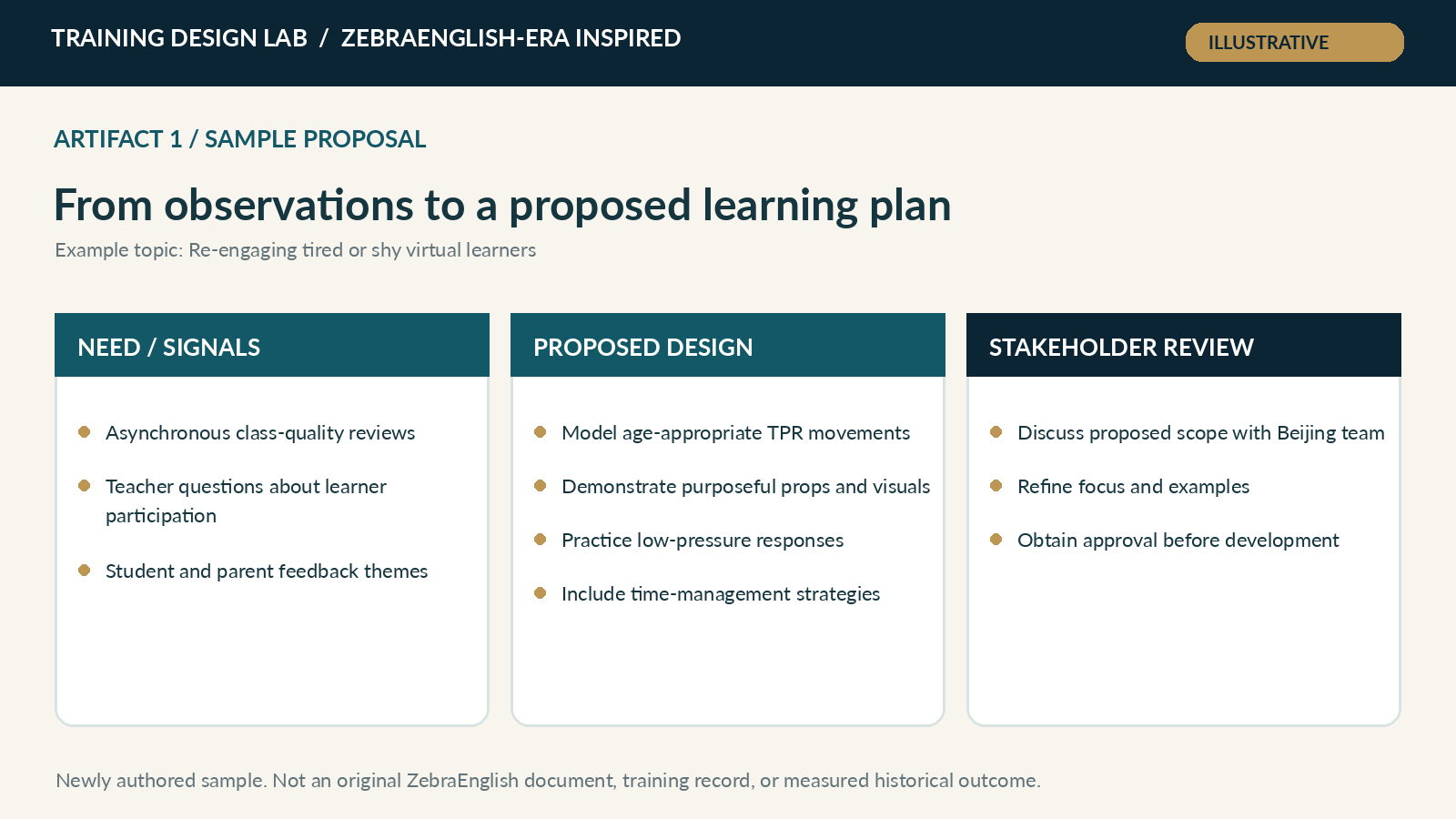
 Instructor development
From Classroom Feedback to Practical Training
Turn training needs, cross-border collaboration, live facilitation, and post-training review into practical instructor development.
View case study →Case study 01 / Technical systems training
Teach the workflow, not just the clicks.
The performance need
A CRM user needs to know whether a lead already exists, what belongs in the record, and why accurate information matters to the next team member.
The learning response
Use a fictional scenario to demonstrate the record, guide practice, and provide a five-step job aid: find, verify, document, assign, review.
Evidence I would seek
Can the learner complete the scenario without prompts? Can another person understand the interaction and act on the follow-up?

A CRM record is more than a collection of fields. It is a communication tool that helps colleagues serve clients consistently. Training should connect each action to that business purpose.
Case study 02 / Distributed onboarding
Give learners a path they can follow.
The performance need
New hires entering independently led teams need dependable guidance without waiting for ad hoc messages or losing track of the next step.
The learning response
Sequence orientation, licensing-related guidance, learning resources, live instruction, and ongoing reinforcement. Pair reusable materials with human support.
Evidence I would seek
Can learners locate the next action and the correct resource? Are common questions decreasing? Can they complete required tasks accurately?
The work can be interpreted through ADDIE—analyze the need, design the journey, develop the resources, implement the learning, and evaluate task performance. This is a retrospective mapping, not a claim that the original program was formally labeled an ADDIE initiative.
Case study 03 / Change enablement
Before retraining, find the real barrier.
Observe the actual work
Find out whether the problem is missing knowledge, unclear expectations, difficult navigation, an access issue, or a genuine system limitation.
Choose the right intervention
Training may help, but so may a clearer process, point-of-need guidance, system-owner involvement, or manager coaching.
Measure what matters
Check task proficiency, approved data-quality signals, repeat help requests, and whether staff can sustain the new workflow.
In earlier work, I investigated a process that could require roughly 30 clicks to locate information. The useful question was not simply how to teach people to navigate it faster—it was how to make the pathway more usable. I do not attach an invented improvement percentage to that experience.
Case study 04 / Live virtual training & instructor development
From classroom feedback to practical training.
At ZebraEnglish, I helped turn classroom quality insights and teacher, student, and parent feedback into relevant professional development for online instructors. The work moved from identifying needs to proposal, Beijing-team review, live delivery, asynchronous access, and evaluation.
A feedback-driven learning cycle
Identify the gap
Our training team examined recorded classes, instructor questions, and feedback from teachers, students, and parents.
Recommend a focus
I developed a training proposal addressing a specific performance issue or recurring teaching challenge.
Work with Beijing
I discussed the proposal with the Beijing team, incorporated requested changes, and obtained final approval.
Build actionable learning
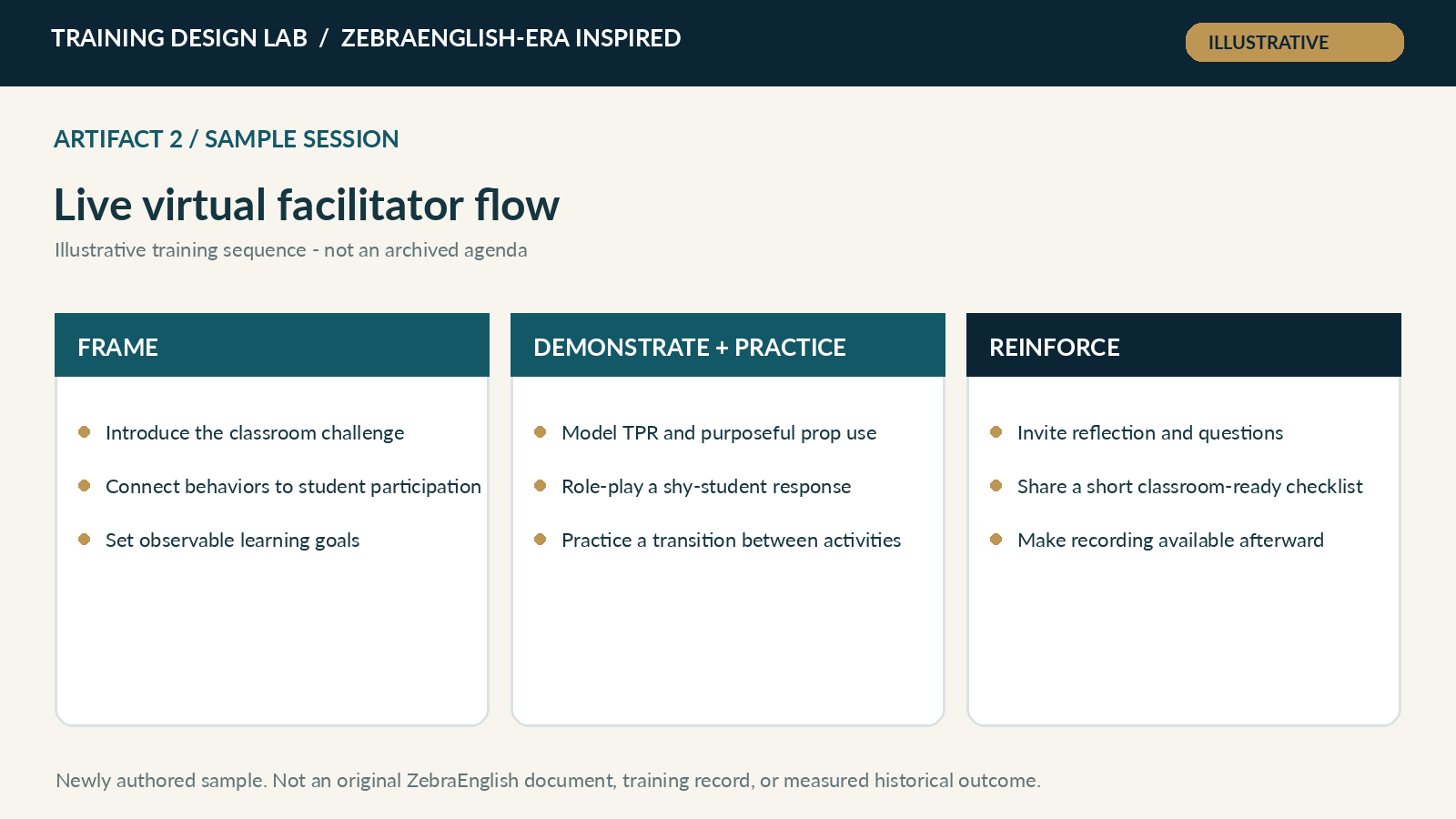
I designed training on topics such as TPR, props, engagement, challenging students, parent concerns, and pacing.
Teach live; replay later
I led live virtual training; session recordings were then made available to teachers for asynchronous viewing.
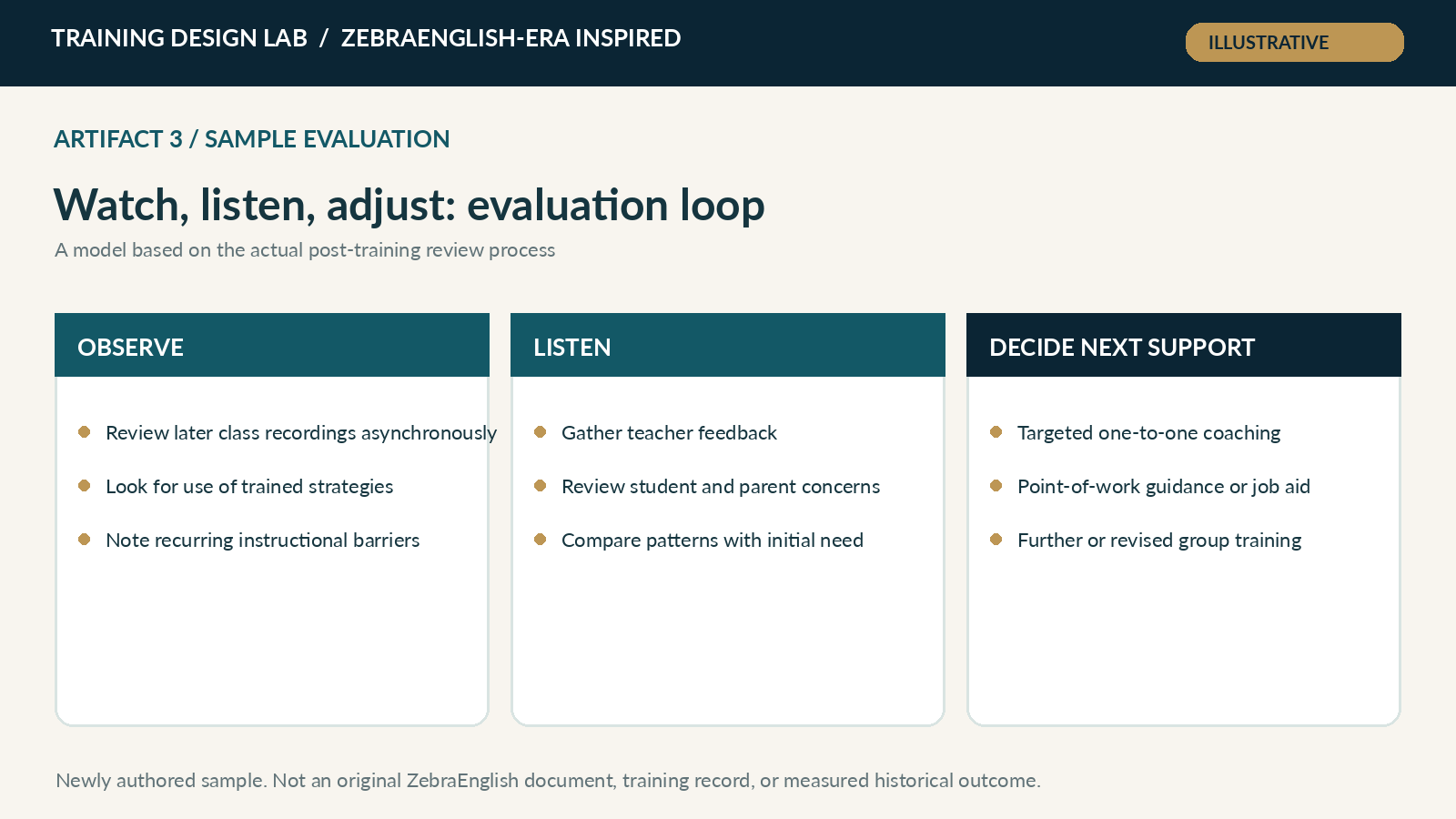
Observe and adapt
We reviewed subsequent class recordings and feedback to decide when to offer targeted coaching, aids, or further training.
Selected instructional examples
Newly designed samples illustrate the types of decisions and resources involved in this work. They are not original employer files or historical reports.
The through-line
Clarity for the learner.
Confidence in the work.
My goal is to create learning that respects employees' time, supports sound decisions, and makes performance easier to sustain. These work samples demonstrate how I approach that challenge.
Download the full selected-work PDF →A note on the samples
Historical experience is summarized at a high level. The fictional learner hubs, CRM records, facilitator views, lesson plans, and adoption examples were developed independently. No confidential employer materials or real client or agent data appear.
Explore my broader professional experience and portfolio work in the Work section.