Build a usable foundation
Understand the business context, role expectations, essential processes, compliance boundaries, and where reliable information lives.
Onboarding · Adult Learning · Systems Readiness · Learning Transfer
A performance-based learning journey for helping new professionals build knowledge, confidence, systems proficiency, and sound judgment.

A strong onboarding program starts with the work a new agent must eventually complete independently. Content, practice, support, and evaluation then align to that definition of readiness.
Understand the business context, role expectations, essential processes, compliance boundaries, and where reliable information lives.
Use systems, make decisions, locate resources, rehearse conversations, and complete realistic tasks with feedback.
Demonstrate competence in authentic conditions while support gradually shifts from instructor-led to manager- and workflow-based.
The roadmap is organized around capability milestones rather than an arbitrary content calendar. The pace should be adjusted to role complexity, risk, learner evidence, and business requirements.
Learning strategy · Practice architecture
Reinforcement · Evaluation
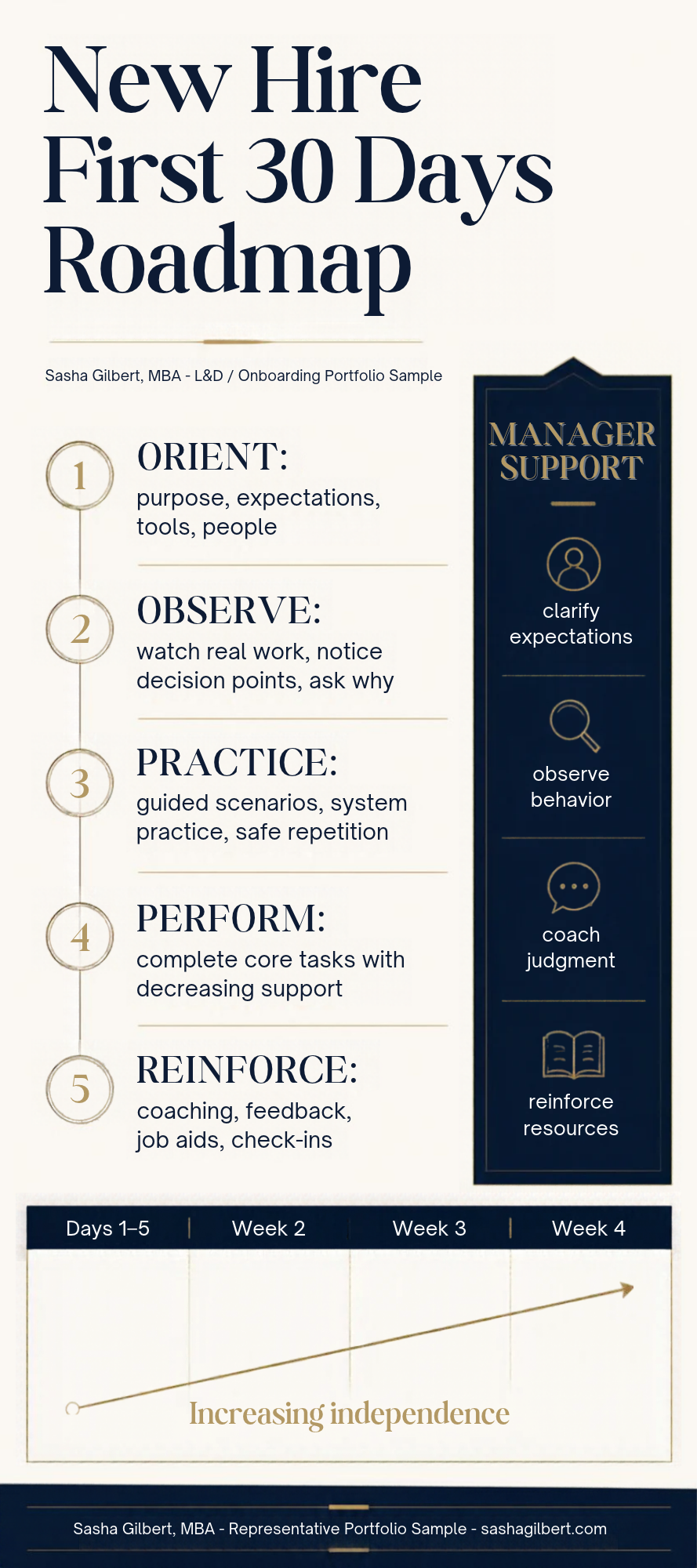
Representative onboarding artifact
The visual roadmap frames onboarding as a path from orientation through supported practice, independent performance, and reinforcement. Manager support remains present while learner independence increases.
Onboarding Design · Learning Journey · Performance Readiness
Created in Canva · Representative Portfolio Sample
Open full viewThe sample alignment map makes the reasoning visible: define the capability, create relevant practice, provide support, and decide what evidence would demonstrate readiness.
Objectives · Practice
Support · Evidence
| Capability | Practice | Point-of-need support | Readiness evidence |
|---|---|---|---|
| Locate accurate information | Find the right resource during a timed, realistic task. | Search guide and resource map. | Uses the current source without unnecessary navigation. |
| Use core systems | Complete guided workflows, then repeat with reduced prompting. | Task-based quick reference. | Completes critical steps accurately and explains key decisions. |
| Conduct customer conversations | Role-play common and difficult scenarios with feedback. | Conversation framework and compliance reminders. | Demonstrates clarity, listening, judgment, and appropriate next steps. |
| Respond to uncertainty | Work through edge cases and decide when to seek help. | Escalation decision tree. | Recognizes limits, verifies information, and escalates appropriately. |
A virtual program needs deliberate bridges between instruction and the workplace. Reinforcement becomes lighter and more contextual as competence grows.
Clarify the standard, model the task, surface prior knowledge, and make the purpose visible.
Observe behavior, ask learners to explain decisions, give specific feedback, and make space for another attempt.
Use manager check-ins, retrieval prompts, job aids, targeted refreshers, and observation to strengthen application.
The evaluation plan avoids invented outcomes. It identifies the evidence a real implementation should collect and the questions that evidence should answer.
Clarity, relevance, accessibility, learner questions, and confidence signals.
Knowledge checks, system simulations, scenario decisions, and teach-back.
Observation, quality evidence, manager feedback, job-aid use, and support needs.
Repeated questions, common errors, workflow friction, and differences between practice and reality.
Capabilities demonstrated
Performance-based onboarding · Adult learning · Backward design · Virtual facilitation · Systems training · Scenario practice · Coaching · Reinforcement · Learning transfer · Evaluation